Artificial Intelligence
Autonomous Compliance Agents: The New Era of Regulatory Compliance in Payments

Introduction: The Rise of AI in Regulatory Compliance
What if financial institutions are no longer overloaded with documents, regulatory changes are implemented in real-time, and compliance officers can concentrate on strategy instead of being buried in reports? This is not some far-off dream; this is the present being created by Autonomous Compliance Agents (ACAs), AI-based systems that are already changing the way that payments companies and banks are navigating the complex world of global regulations.
The Compliance Issue in Payments
Traditional compliance management requires the involvement of compliance teams responsible for identifying the regulations that apply to the organization, monitoring the transactions made, and preparing the necessary reports. Non-compliance can lead to penalties, losses of reputation, and legal actions. Payments companies that operate in an environment of rapid changes need new and innovative strategies to address these challenges and prevent compliance gaps.
What Are Autonomous Compliance Agents?
ACAs are technological solutions that apply artificial intelligence, machine learning, and natural language processing to improve regulatory compliance management. Unlike the conventional compliance software that works like a simple calculator applying a set of rules, ACAs work more like a team of lawyers, data analysts, and auditors to maintain and improve compliance posture.
They incorporate some of the following capabilities:
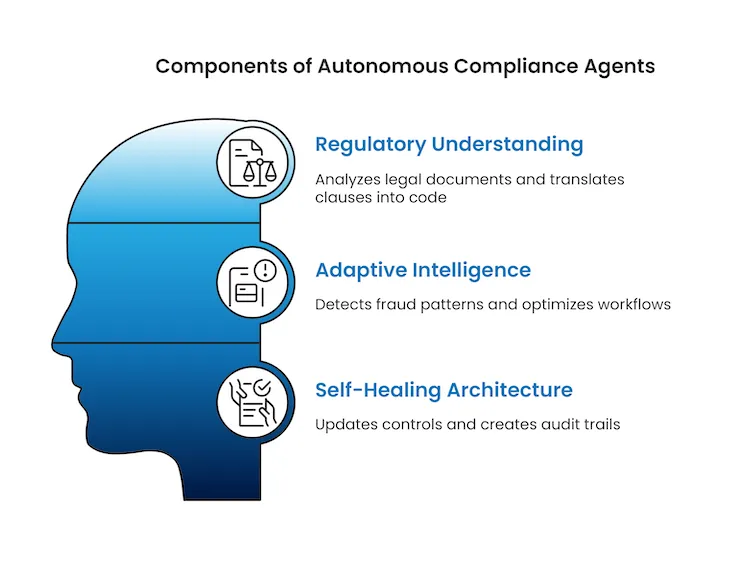
Regulatory Understanding
- Natural Language Processing (NLP) analyzes legal documents such as SEC filings and AML directives.
- Semantic Mapping translates clauses into code. For example, “customer due diligence” is mapped to API calls for ID verification.
- Conflict Resolution identifies jurisdictional clashes (e.g., New York’s BitLicense versus federal crypto guidelines).
Adaptive Intelligence
- Graph neural networks to understand the hidden relationships between entities to detect complex fraud patterns.
- Reinforcement Learning optimizes the workflows according to the regulator’s feedback and improves with every case.
Self-Healing Architecture
- Updates compliance controls when regulations change for instance, CFPB’s Buy Now, Pay Later rules.
- Creates audit trails with cryptographic proof of compliance.
How Do ACAs Work?
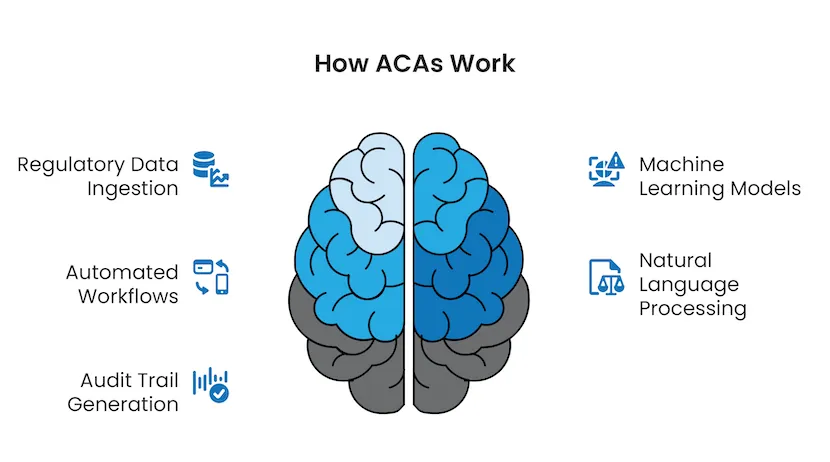
Regulatory Data Ingestion – In the current world, ACAs monitor regulatory databases, legal documents, and policy changes in real-time.
Machine Learning Models – The AI models identify the anomalies in the financial transactions and ensure that the AML, KYC, and other standards are complied with.
Automated Workflows – The ACAs are integrated with payments platforms to identify suspicious activities, request more information, or even block a transaction if it is fraudulent.
Natural Language Processing – NLP enables ACAs to translate complicated legal clauses and derive meaningful information from regulatory texts.
Audit Trail Generation – The ACAs record all the compliance decisions made to meet the requirements of an audit trail.
5 Key Benefits of AI-Powered Compliance Management Solutions
- Cost Reduction
By automating compliance, payments companies can downsize their compliance departments and, therefore, reduce operational costs.
- Real-Time Compliance Monitoring
ACAs work 24/7, ensuring regulatory compliance is maintained without delay or forgotten.
- Scalability
As payments businesses grow, the ACAs can expand to manage more transactions and compliance issues.
- Improved Fraud Detection
With the help of pattern recognition techniques, AI-based ACAs can detect fraudulent transactions that human analysts may miss.
- Regulatory Adaptability
The framework of AI compliance agents gets updated automatically with the new regulations, so manual intervention is unnecessary.
Real-World Applications in Payments
Automated KYC/AML – Payments platforms employ ACAs to identify customers and prevent money laundering.
Regulatory Reporting – ACAs generate and submit compliance reports to the regulatory authorities to minimize reporting costs.
Risk Assessment for Loans – ACAs check for lending regulations and minimize credit risks for the payments lenders.
Crypto Compliance – Cryptocurrency platforms use the ACSs to verify whether transactions comply with anti-fraud and anti-money laundering laws.
Challenges and Considerations in AI-Driven Compliance
- Data Privacy & Security
The ACAs deal with financial information; thus, cybersecurity and data protection are essential.
- Algorithmic Bias
AI models must be trained on diverse data sets to avoid making biased decisions in compliance.
- Regulatory Acceptance
Financial regulators may demand evidence of effectiveness and precision before allowing ACAs to become the standard for compliance.
- Integration Complexity
It is vital to remove barriers that limit or prevent proper integration with existing payments infrastructures to maximize the effectiveness of ACAs.
The Future of AI in Regulatory Compliance
As AI technology continues to develop, the ACAs will be able to perform multi-jurisdictional compliance, regulatory change identification, and more complex workflow automation. Early adopters of ACAs will be well-positioned to lower their compliance risks and costs and enhance operational efficiency.
Conclusion: Embracing AI for Smarter, More Efficient Compliance
Autonomous compliance agents are changing the payments industry and how regulatory compliance is managed. With the help of AI automation, payments organizations can concentrate on developing new services and products while meeting regulatory requirements in real-time. Thus, ACAs will become an essential component of compliance management in the financial services and payments industries. If you are weighing where AI fits in your own compliance workflows, see how we approach AI strategy and implementation or book a discovery call.
Newsletter
Subscribe to newsletter
Subscribe to receive the latest blog posts to your inbox every week.